
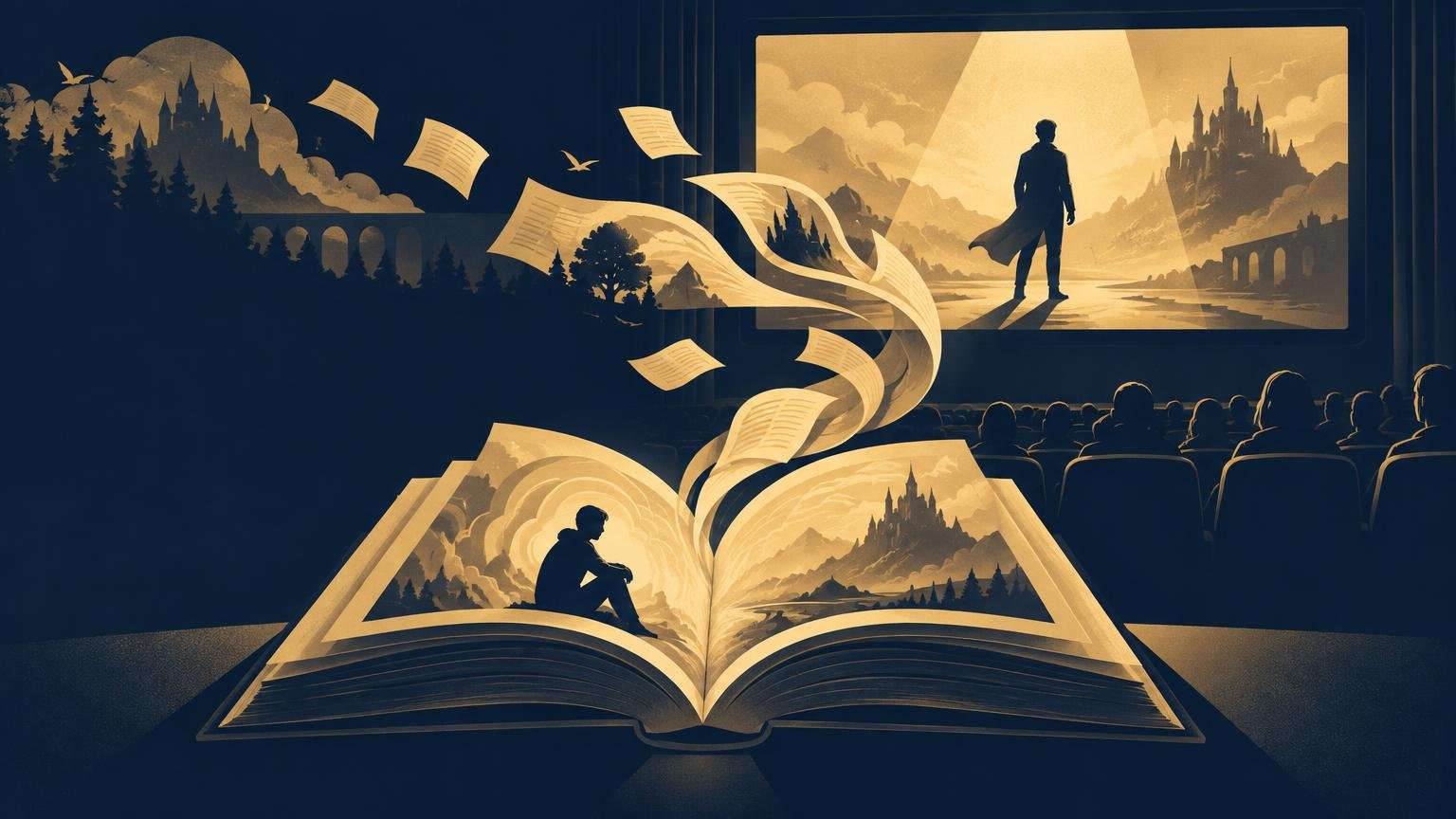
Book vs Movie Adaptation: What Gets Lost When the Story Changes Mediums?
TLDR
In a book vs movie adaptation, the book is usually the better first choice if you care most about prose, inner life, ambiguity, and time with the characters. Choose the movie first if you want a quicker entrance through performance, imagery, music, and focused pacing. Neither medium automatically gives you the “real” or superior experience. The useful question is what each version asks you to notice, imagine, and feel.
The most obvious adaptation losses are scenes, characters, explanations, and subplots. The deeper changes, however, involve access. A novel may let us inhabit a character’s thoughts for pages; a film may replace that access with a glance, a cut, a silence, or a piece of music. Comparing the two as if they were containers holding the same material misses what happens when a story changes the way it reaches us.
A story does not survive adaptation unchanged
A movie based on a novel is not an illustrated summary of that novel. It is a new work made from existing source material. The Writers Guild of America’s screen-credits guidance formally treats previously published works such as novels as source material for adapted screenplays. That terminology matters: the screenplay comes from the book, but it must become a workable dramatic text of its own.
Adaptation is therefore a process of selection and transformation. Linda Hutcheon and Siobhan O’Flynn’s A Theory of Adaptation presents adaptation as a broad creative practice that moves stories across media rather than merely copying them. The Library of Congress similarly notes that filmmakers may alter source material to heighten drama or emphasize particular elements.
Something will change because the storytelling instruments have changed. A novelist can summarize a decade in one sentence, spend a chapter inside a memory, or hide information through an unreliable voice. A filmmaker can make a room feel threatening before anyone speaks, expose a lie through an actor’s expression, or connect two events through editing. Each version controls attention differently.
What the book can give you
A book’s great advantage is not simply that it contains more. Its advantage is that language itself can become the experience. Sentence rhythm, word choice, metaphor, and narrative distance determine how close we feel to a character and how much we trust what we are told.
First-person narration can trap us inside one person’s interpretation. Free indirect style can move between a narrator’s language and a character’s private assumptions until the boundary becomes difficult to see. Even a detached narrator can shape sympathy by choosing what to explain, conceal, repeat, or dismiss.
Books also give readers unusual control over time. You can pause over a sentence, reread a clue, linger in a description, or race through a confrontation. That freedom affects emotional intensity. A revelation discovered after several evenings of reading may carry the weight of accumulated companionship in a way that a compressed screen story cannot reproduce exactly.
This is why cutting a paragraph of thought can matter more than cutting an entire event. The event may survive, but the reason it hurts—or the reason we misread it at first—may have lived in the narration.
What the movie can add
Film gains meaning through bodies, voices, images, sound, editing, and shared duration. An actor can introduce hesitation into a confident line. Production design can reveal class, isolation, or disorder without pausing for description. Music can create dread or tenderness before the audience knows why. A cut can turn two separate images into an argument.
Film also makes some choices unavoidable. A reader may imagine a setting only loosely, but a movie must show or strategically withhold it. Casting gives a character a particular face, age, voice, and physical presence. Pacing is imposed rather than individually controlled: the audience remains in a silence for as long as the edit requires.
Those apparent restrictions can produce new power. A film may make a background character suddenly compelling because a performance communicates more than the screenplay states. It may create visual parallels that do not exist in the prose. It can also make violence, intimacy, or social tension harder to hold at an imaginative distance.
What usually gets lost in a book vs movie adaptation
The most common loss is interiority: direct access to thought, memory, self-deception, and association. Voice-over can preserve some narration, but spoken excerpts do not automatically reproduce the experience of living inside prose. The words now arrive with an actor’s voice, images selected by filmmakers, and a pace the viewer cannot control.
Adaptations also tend to lose narrative space. Secondary relationships may disappear, several characters may be combined, and repeated incidents may become one representative scene. A film can preserve the plot while changing its proportions. If a novel devotes substantial attention to work, family, or community but the movie concentrates on romance, the same main events can produce a different thematic center.
Ambiguity may narrow as well. Prose can sustain competing interpretations through uncertain narration or carefully limited information. A film’s casting, framing, and performance may make one interpretation feel dominant even when the script never states it outright.
But “lost” does not always mean “damaged.” Repetition that creates texture in a novel may become inert on screen. A subplot that deepens the book may interrupt the movie’s dramatic line. The fair question is not whether material vanished. It is whether the adaptation found another way to perform the material’s emotional or thematic work.
Should you read the book or watch the movie first?
| Your priority | Start with | Why |
|---|---|---|
| Original voice and inner life | The book | You encounter the story through its prose and narrative point of view before performances shape your interpretation. |
| A quick entrance into the story | The movie | Image, sound, performance, and concentrated pacing can establish the world efficiently. |
| Preserving plot surprises | The book | You experience revelations in the structure and language in which they were first presented. |
| Understanding a complex cast or setting | The movie | Faces, locations, costumes, and visual relationships may provide an accessible orientation. |
| Studying adaptation choices | Either | The second version will feel like the transformation, so changing the order changes what you notice. |
| Avoiding disappointment about omissions | The movie | Reading afterward can feel like expansion rather than watching familiar material disappear. |
If you already know you are sensitive to spoilers, read first. A movie can reveal a novel’s central turns even when it changes how they happen. If dense description or a large cast is preventing you from beginning, watching first can provide a useful map. Knowing the broad destination does not eliminate the pleasures of voice, structure, and interiority.
Order also creates bias. Book-first readers often measure the movie by absence: Where is the scene I loved? Movie-first readers may measure the book by delay: Why is this taking so long? Recognizing that bias makes the second experience more interesting. Instead of waiting for it to reproduce the first, notice what becomes newly possible.
Why movies cut, combine, reorder, and invent
A cut scene is not automatically evidence that filmmakers misunderstood the book. Every retained element competes for attention and affects momentum. Combining two supporting characters may preserve their plot function, though it can also flatten the different relationships they represented. Moving an event earlier may clarify motivation while sacrificing mystery. Inventing a scene may externalize a conflict that the novel presented through thought.
- Compression reduces the number of events or people needed to carry the main dramatic movement.
- Reordering changes when the audience learns something, often shifting suspense, sympathy, or surprise.
- Externalization turns thoughts, memories, or explanation into visible action and dialogue.
- Changed emphasis moves attention toward a theme, relationship, or character that the filmmakers consider central.
- Invention creates material that performs a function the source handled through narration or structure.
Each choice has a cost. The point is not to excuse every alteration but to identify what the alteration accomplishes and what it gives up. “They changed it” begins the discussion; it does not finish it.
Faithfulness is useful, but it is not the only test
Fidelity matters because changes can weaken characterization, simplify difficult themes, or replace a challenging ending with a more comforting one. Readers are not wrong to care when an adaptation abandons what made the source distinctive.
Yet fidelity remains a contested idea in adaptation studies, as this discussion of adaptation and fidelity from Oxford Academic explains. A movie can reproduce incidents accurately while missing the book’s tone. Another can alter the plot but build a persuasive equivalent for its emotional pressure. Literal similarity and artistic success are related, but they are not identical.
A stronger comparison asks whether the filmmakers understood the function of what they changed. If the book’s ending leaves the protagonist morally unresolved, does the movie preserve that discomfort or convert it into certainty? If the novel limits us to one unreliable perspective, does the film find a visual way to sustain doubt? If it does not, the important criticism is not simply that the ending or point of view changed. It is that the audience is now being asked to feel something different.
A better way to compare the two versions
Choose one important scene shared by both versions and examine it through six questions:
- Point of view: Whose experience controls the scene, and can we access that person’s thoughts?
- Information: What does the audience know at this moment, and what is being withheld?
- Characterization: Which action, sentence, expression, or omission shapes your judgment of the characters?
- Tone: Does the scene feel comic, tender, frightening, bitter, or uncertain in each version?
- Pacing: Where does each version linger, and what does it hurry past?
- Aftereffect: What are you encouraged to feel or reconsider when the scene ends?
This approach turns comparison into interpretation. You may discover that the movie removed your favorite line but preserved its meaning through performance. You may find that a visually beautiful scene softens the book’s cruelty. You may also notice that the novel’s additional detail does not merely explain more; it delays judgment until you have become implicated in a character’s way of thinking.
The best adaptation question is about effect
The book is not always better, and the movie does not replace it. They are related experiences with different ways of controlling knowledge, time, distance, and emotion. Books often excel at voice and inwardness. Movies can make gesture, sound, physical space, and collective tension newly powerful.
After experiencing both, return to one shared scene rather than making a list of every omission. Compare what the book lets you imagine or inhabit with what the movie makes you see and hear. Then ask the question that reveals the real adaptation: What changed in you when the story changed mediums?
References
- Screen Credits Manual
- A Theory of Adaptation – 2nd Edition – Linda Hutcheon – Siobhan O'Flyn
- Books That Became Movies – At the Movies: Military Fiction and Nonfiction on Film – Research Guides at Library of Congress
- Adaptation and Fidelity | The Oxford Handbook of Adaptation Studies | Oxford Academic